…and Bad News on Belo Monte

Not unexpectedly, but still disappointingly, the President of the Supreme Court, Carlos Ayres Britto, has suspended the injunction which halted work on the dam.

In a move which represents a total capitulation of the Supreme Court to the wishes of the Executive he refused to comment on the legal aspects, but nonetheless suspended the injunction until the case reaches a full Supreme Court hearing.

How is this a total capitulation? According to Norte Energia, the company building the dam, the government has already spent the major part of R$5 billion through the largely nationally-owned companies which form the core of Norte Energia, and it is incurring further costs daily. Immense damage has already been done in terms of the destruction of the physical, social, cultural and food security of the indigenous tribes affected. The environment suffers more with each day that work progresses. We are at, or very close to, the point where the damage done is irreversible, and the investment so huge that no judgement from any court could stop the Leviathan’s progress.

No date has been set for a hearing in the Supreme Court. The case is unlikely to reach the Court for months or even years, by which time the dam will be more or less built, the destruction will have already have been done, the indigenous cultures will have been wiped out, and therefore the case will be no more than academic.

Ayres Britto seems to be blind to the fact that the government has succeeded in bypassing the country’s constitution and huge swathes of its environmental and human rights legislation. Because of the enormity of the project, judging that a fait accompli was carried out illegally can do nothing to reverse the damage done. The Supreme Court will have no sanction available; at worst the government may receive a slap on the wrist, which it will simply shrug off on its march towards the next illegal mega-project on the next river.

It is sad to see Brazil’s young democracy suffer such degradation. Without a proper balance between the Three Powers – which are so iconically at the heart of Brasilia, where the Executive, the Judiciary and Congress all sit on the Square of the Three Powers – Brazil is reverting to a dictatorship, with a Judiciary cowed into submission by an all-powerful Executive, which in turn is endorsed by a supine and submissive Congress, influenced and financed by corporate interests.

We watched through the 1980s as Brazil left the years of dictatorship behind. We were in awe as the country swept into a new age of enlightenment, enacting progressive laws to protect the rights of its citizens, whether rich or poor, black or white, immigrant or indigenous. The adoption of the 1988 Constitution was a high point, and the hosting of the 1992 United Nations Earth Summit was a triumph. Brazil was seen throughout the world as a bright star, a shining example of how a young democracy could vigorously defend what was good and humanitarian.

How sad to see such promise dashed. Mired in wave after wave of corruption at the highest level – ironically the Supreme Court cannot judge the Belo Monte case because it is embroiled in the Mensalão case, which is about corruption in the highest ranks of the government – Brazil’s burgeoning wealthy elite are following the worst example of their gurus in the developed world and enriching themselves with no thought for those who are paying the price for their riches.

The government is enthusiastically endorsing policies and legislation which has no other intention but to take away the safeguards built so painstakingly into the fabric of the modern Brazilian state. First, the courageous and far-reaching (if poorly enforeced) Forest Code was watered down, paving the way to rising deforestation and increased conflict over land tenure. Now there is a project to change the constitution (known as PEC 215) which will transfer responsibility for demarcation of indigenous territories from FUNAI to the National Congress, where each and every proposal will be bogged down for years unless it is simply dismissed at the outset. There is the crazy AGU 303 decree referred to in another article here. And there are the multiple mega projects planned for the Amazon which will result in no more nor less than cultural genocide.

President Dilma Rousseff appears disinterested in anything which might impede her developmentalist agenda for the Amazon. She seems to look upon anyone and anything which is not part of the rich, new world of Brazilian economics and business as a trifling impediment to be brushed aside, whether they be indigenous people, rural settlers, threatened species or ecosystems. She has her priorities and nothing and no-one may be permitted to stand in her way.

Good News on Belo Monte

In a decision which has fundamental implications for the Brazilian government’s relationship with indigenous people, the Federal Regional Court 1 (TRF1) in Brasilia unanimously upheld an earlier decision by the Federal Court in the State of Pará on appeal. The court ruled that the 2005 Congressional Decree which allowed the Belo Monte dam project to be developed was illegal, and accordingly annulled it. The effect is that all of the subsequent environmental licensing process is also invalid. The appeal court also upheld the lower court’s decision that the Government acted in flagrant breach of the United Nations International Labour Organisation Convention 169, of which Brazil is a signatory and which is therefore incorporated into Brazilian Law.

This decision is extremely important. It recognises that the Brazilian government has failed to respect fundamental issues of legality, including its own constitution, its own human rights and environmental legislation, and its international obligations. It was handed down unanimously by three judges sitting in a higher court in the capital. It is made on the basis of the legislation and irrespective of the government’s overriding ambitions. And it is unequivocal in its condemnation.

The court imposed an immediate halt to the construction of the dam, with a daily fine of R$500,000 for any breach. In an interview following the ruling, Judge Souza Prudente was damning; “We are not fighting the government’s acceleration project,” he said. “But it cannot be a dictatorial process. The communities are crying out to be heard but they continue to be ignored. The model of preliminary authorisations followed by studies after the event for hydroelectric dams needs to be looked at again because it is authoritarian and unacceptable.”

Public Prosecutor Felicio Pontes, the author of the original action, said “The legislative decree which authorised Belo Monte without consulting the Indians was a truly monumental affront to the Constitution.” According to him, because the judgement relates to the constitution, the only recourse open to the government now is an appeal to the Supreme Court.

If it chooses to respect this decision, the government will have to go back to the beginning and instigate properly-constituted consultations with the indigenous communities involved, which have to be carried out by Congress and not by the partisan organisations which have so far been involved with the consultations – such as they were – carried out as part of the licensing process. It will then have to go through the steps of obtaining approval from the government agencies involved before it can issue new licenses, since those already in place are no longer valid.

But it is unlikely that the government will be willing to take this legal and democratic route. The same court handed down a judgement a week earlier on another dam project, on the Teles Pires River, in which its judgement was based on the same issues. Again the judgement was unanimous and unequivocal. But just a week later the President of TRF1, Mário César Ribeiro, sitting in chambers, set aside the injunction and permitted the continuation of work on the Teles Pires pending a further appeal. It seems likely that we will see this same process of a judge sitting secretly in chambers overturning the decision of a panel of judges sitting under public scrutiny in an open court in the case of Belo Monte.

Nonetheless, this decision is a great triumph for the cause of the environment, indigenous people and Brazilian democracy and justice. It represents a landmark in the relationship between the executive and the judiciary, with the judiciary finally being prepared to stand up for their own independence and authority in the face of enormous pressure from the Rousseff government.

Hello From Rio+20

We’re at the end of Rio+20, the grandly-named United Nations Conference on Sustainable Development, twenty years on from the landmark Earth Summit of 1992.

If anyone was relying on Rio+20 as a landmark I would suggest investing in a satnav, because the only thing remarkable about this landmark is its insignificance.

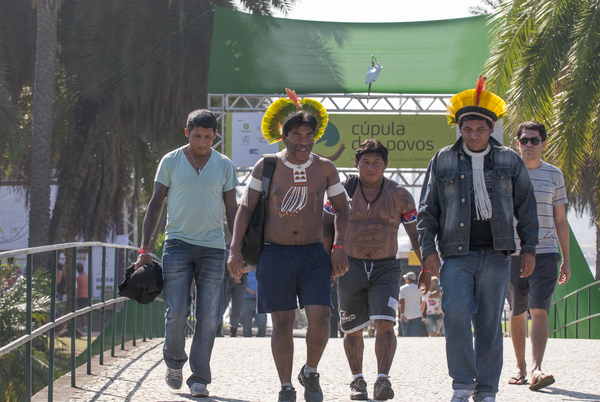
Cynicism aside, parallel to the UN conference was the People’s Summit, an hour away in Rio’s Flamengo Park, where there was visibly more commitment, passion and action. It was at the People’s Summit that the indigenous delegations spent most of their time, and they were a powerful and influential presence. They drew massive support and respect from the general public. More than 1,500 indigenous people from all over Brazil, South America and the world were here.

Kayapo Indians Arriving at the People's SummitThough our Just Giving campaign to raise funds to help some of the communities we work with to attend was a massive disappointment, we did receive substantial grants from the Roddick Foundation and Artists Project Earth at the last minute, which helped two communities to send representatives whose voices would not otherwise have been heard. We extend our thanks from them to the few who did donate; your money went to help feed those who were here when it became apparent that the food provided for them was both very poor quality and vastly insufficient.

Brazilian indigenous protestor at Rio+20Inevitably there was much discussion and several peaceful but forceful actions about the Belo Monte hydroelectric dam, which is moving ahead despite legal challenges from Brazil’s public prosecutors, the UN and the Inter American Committee on Human Rights. We went to the launch of ‘Xingu: A Declaration of War’, a full-length documentary film. I recommend it to anyone interested in indigenous peoples, human rights, the Amazon environment – or sustainable development – it runs 1hr 44mins, is free to distribute and is sobering. Because we know practically all of the people who feature in the film personally, we can vouch for its accuracy in representing their views. Here’s the link to the site:

Xingu: A Declaration of War

You can see some of Sue Cunningham’s photos from Rio+20 on her commercial website:

Sue Cunningham Photographic Rio+20 Photo Galleries

and Patrick Cunningham submitted a report to the Latin America Bureau website:

Latin America Bureau

Rio+20: United Nations Conference on Sustainable Development, June 2012

Rio+20 – A Bit of History

Rio in 1992 – UNCED: 172 countries, 108 Heads of State – Climate Change & Biodiversity Conventions. Patchy implementation and progress since, overshadowed by corporate growth – TNCs and the WTO. Conflict between profit and the Environment.

UNCED Logo from 1992

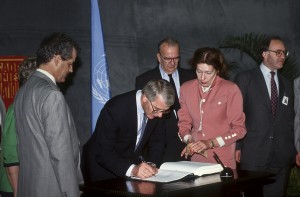
Twenty years ago, 172 of the world’s leaders, including 108 Heads of State – our own Prime Minister John Major and the US President George Bush (the elder) included – met in Rio de Janeiro, Brazil for a groundbreaking world conference, the United Nations Conference on Environment and Development, UNCED. They signed into effect two crucial United Nations treaties; the Climate Change Convention and the Biodiversity Convention.

These two binding treaties, together with three further agreements – Agenda 21, the Rio Declaration and the Statement on Forest Principles – were the basis for a plethora of effective and forward-looking projects, programmes and laws, on every level from the smallest Agenda 21 project affecting just a small plot of community land to international efforts to control climate change and protect biodiversity.

John Major signing the Biodiversity Convention, UNCED 1992

John Major signing the Biodiversity Convention

The development of these has been patchy and has fallen short of hopes and expectations, but overall we are in a very much better position in the 21st century than would have been the case without UNCED.

But all the gains made on the environmental front have been overshadowed by the explosive growth in consumption and the rapid expansion of trans-national corporations (TNCs) whose motivation is driven by only one thing – profit. In 1990 there were 3,000 TNCs; today there are 63,000!

The intervening years have also seen the establishment of the World Trade Organsiation (WTO), the most powerful and effective UN organisation ever. Often the WTO is in direct conflict with the vital needs of the environment, and sadly it is usually the WTO which takes precedence.

Where To Now?

Environment in second place to profit – danger of environmental disintegration – need for change – the place of indigenous people – Running Out Of Time – TNCs as part of the solution with their resources and dynamism.

If we carry on along the road we are on, the interests of the environment will always take second place to those of the TNCs and international finacial institutions, with disastrous consequences – spiralling environmental degradation, ever-diminishing water resources, out-of-control climate change and growing human impoverishment. We need to change. And Rio+20 is an excellent focus through which we can initiate that change.

Asurini Woman with Sweet potatoes

Asurini Woman with Sweet potatoes

The indigenous people who will attend Rio+20 are charismatic and visually compelling. Because their entire cultures and ways of life depend on their close interrelationship  with the natural environment they will be putting the case for protecting the planet’s wild ecosystems in a robust way.

Scientists, environmentalists and civil society groups are worried that time is running out. Unfortunately the draft proposals from the UN for Rio+20 are weak, non-binding and a poor compromise. The only way that something positive will come out of Rio is if the non-UN sector comes together with one voice to demand change.

And change can come. Within the TNCs there is a growing awareness that they are locked into a dangerous path of growing and unsustainable natural resource consumption, but they are effectively prisoners of the profit motive – which is underpinned by legal obligations and hemmed in by the underlying structure of our world economy.

Petrobras Research Centre

Petrobras Research Centre

We need the TNCs to become part of the solution to the problem, because they control the bulk of the resources we need to rapidly re-focus the economy. By the year 2000, 53 of the largest economic entities in the world were corporations, not countries, each one with more wealth than over 120 nation states. We need their resources, we need their expertise and we need their entrepreneurship if we are to change the course of humanity in time to head off climate change and resource over-exploitation before it is too late.

Indigenous People; Part of the Solution

Indigenous people suffering from resource over-exploitation, have the understanding and spiritual relationship with the Earth – their long-term view to the sixth generation.

Indigenous people are at the receiving end of this over-exploitation. It is they whose land is scarred and despoiled by mining operations, it is they whose villages are flooded – or denied water – by mega hydroeletric dams, and it is they whose sources of sustenance and well-being are stolen when the forest is felled to make way for soya, cattle and biofuels. Pressures on indigenous people the world over have been ratcheting up rapidly in the 21st century and show no signs of reducing.

Warrior Phinya Matipu

Warrior Phinya Matipu

Yet it is also they who have the understanding of the natural environment and the respect for the balance inherent in a proper relationship between man and nature. Their strong spiritual belief in man’s integration in the totality of the global environment would not have allowed them to embark on the profligate and careless despoilment of the earth which we have seen in the last 250 years. They plan with the well-being of the next six generations in mind; with that as a starting point we could never have made the myriad wrong turns we have.

We need to listen to them. We need to take on board the interests of the sixth generation. Our planning cannot be in terms of five-year plans, nor can we base our politics on the need to face the electorate in a few years. Our idea of long-term planning is inadequate and pitiful.

What Can Rio+20 Deliver?

The Future We Want, Rio+20With the UN’s ambition practically at zero, Rio+20 has to look to a movement of the peoples of the world, indigenous and rural, urban and metropolitan, remote and mainstream, for any progress. By uniting people in a call for change, in a shout for the re-balancing of civilisation, Rio+20 can be the starting point for a dynamic shift in public perception which will force our national and international institutions to re-shape themselves.

Let’s do it!


Would you like to know more? For a longer discussion in pdf format, go here