
Rio+20 – A Bit of History
Rio in 1992 – UNCED: 172 countries, 108 Heads of State – Climate Change & Biodiversity Conventions. Patchy implementation and progress since, overshadowed by corporate growth – TNCs and the WTO. Conflict between profit and the Environment.

Twenty years ago, 172 of the world’s leaders, including 108 Heads of State – our own Prime Minister John Major and the US President George Bush (the elder) included – met in Rio de Janeiro, Brazil for a groundbreaking world conference, the United Nations Conference on Environment and Development, UNCED. They signed into effect two crucial United Nations treaties; the Climate Change Convention and the Biodiversity Convention.
These two binding treaties, together with three further agreements – Agenda 21, the Rio Declaration and the Statement on Forest Principles – were the basis for a plethora of effective and forward-looking projects, programmes and laws, on every level from the smallest Agenda 21 project affecting just a small plot of community land to international efforts to control climate change and protect biodiversity.
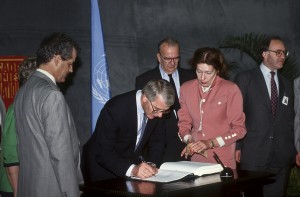
John Major signing the Biodiversity Convention
The development of these has been patchy and has fallen short of hopes and expectations, but overall we are in a very much better position in the 21st century than would have been the case without UNCED.
But all the gains made on the environmental front have been overshadowed by the explosive growth in consumption and the rapid expansion of trans-national corporations (TNCs) whose motivation is driven by only one thing – profit. In 1990 there were 3,000 TNCs; today there are 63,000!
The intervening years have also seen the establishment of the World Trade Organsiation (WTO), the most powerful and effective UN organisation ever. Often the WTO is in direct conflict with the vital needs of the environment, and sadly it is usually the WTO which takes precedence.
Where To Now?
Environment in second place to profit – danger of environmental disintegration – need for change – the place of indigenous people – Running Out Of Time – TNCs as part of the solution with their resources and dynamism.
If we carry on along the road we are on, the interests of the environment will always take second place to those of the TNCs and international finacial institutions, with disastrous consequences – spiralling environmental degradation, ever-diminishing water resources, out-of-control climate change and growing human impoverishment. We need to change. And Rio+20 is an excellent focus through which we can initiate that change.

Asurini Woman with Sweet potatoes
The indigenous people who will attend Rio+20 are charismatic and visually compelling. Because their entire cultures and ways of life depend on their close interrelationship with the natural environment they will be putting the case for protecting the planet’s wild ecosystems in a robust way.
Scientists, environmentalists and civil society groups are worried that time is running out. Unfortunately the draft proposals from the UN for Rio+20 are weak, non-binding and a poor compromise. The only way that something positive will come out of Rio is if the non-UN sector comes together with one voice to demand change.
And change can come. Within the TNCs there is a growing awareness that they are locked into a dangerous path of growing and unsustainable natural resource consumption, but they are effectively prisoners of the profit motive – which is underpinned by legal obligations and hemmed in by the underlying structure of our world economy.

Petrobras Research Centre
We need the TNCs to become part of the solution to the problem, because they control the bulk of the resources we need to rapidly re-focus the economy. By the year 2000, 53 of the largest economic entities in the world were corporations, not countries, each one with more wealth than over 120 nation states. We need their resources, we need their expertise and we need their entrepreneurship if we are to change the course of humanity in time to head off climate change and resource over-exploitation before it is too late.
Indigenous People; Part of the Solution
Indigenous people suffering from resource over-exploitation, have the understanding and spiritual relationship with the Earth – their long-term view to the sixth generation.
Indigenous people are at the receiving end of this over-exploitation. It is they whose land is scarred and despoiled by mining operations, it is they whose villages are flooded – or denied water – by mega hydroeletric dams, and it is they whose sources of sustenance and well-being are stolen when the forest is felled to make way for soya, cattle and biofuels. Pressures on indigenous people the world over have been ratcheting up rapidly in the 21st century and show no signs of reducing.

Warrior Phinya Matipu
Yet it is also they who have the understanding of the natural environment and the respect for the balance inherent in a proper relationship between man and nature. Their strong spiritual belief in man’s integration in the totality of the global environment would not have allowed them to embark on the profligate and careless despoilment of the earth which we have seen in the last 250 years. They plan with the well-being of the next six generations in mind; with that as a starting point we could never have made the myriad wrong turns we have.
We need to listen to them. We need to take on board the interests of the sixth generation. Our planning cannot be in terms of five-year plans, nor can we base our politics on the need to face the electorate in a few years. Our idea of long-term planning is inadequate and pitiful.
What Can Rio+20 Deliver?
 With the UN’s ambition practically at zero, Rio+20 has to look to a movement of the peoples of the world, indigenous and rural, urban and metropolitan, remote and mainstream, for any progress. By uniting people in a call for change, in a shout for the re-balancing of civilisation, Rio+20 can be the starting point for a dynamic shift in public perception which will force our national and international institutions to re-shape themselves.
Let’s do it!
Would you like to know more? For a longer discussion in pdf format, go here