Report Back: Visit of Chiefs Raoni and Megaron

The summer has passed and we are now in the bracing clutches of autumn. Yet it seems only a few weeks ago that we had the immense pleasure of hosting Raoni Metuktire and Megaron Txucarramae, leaders of the Kayapo and spokesmen for all of Brazil’s indigenous peoples, in our home.

Chiefs in front of the House of Commons

The Chiefs in front of the House of Commons

Their visit was a whirlwind. They would have liked a little time to see our country, and we wanted very much to show them some of the sights that date back to tribal times in England, like Stonehenge and the Uffington White Horse.

But that was not to be; despite having very short notice of their visit we managed to put together a full programme, including open meetings at Oxford University and University College London, a meeting with senior-level MPs at the House of Commons and media interviews. They met with Survival International and the Gaia Foundation, and the Rainforest Foundation helped us to put on a press conference, chaired by Bianca Jagger. They even had a private meeting with Prince Charles.

We have produced a short video report of the visit:

Outcomes

British politicians active in the areas of international environment and human rights are now better informed about the situation on the ground in the Amazon. The impact of this is difficult to evaluate because the results are not always obvious.

Meeting at Parliament

Meeting at Paliament

The visit has elevated the public profile of Brazil’s indigenous peoples and highlighted the Brazilian government’s lack of commitment to supporting and prioritising environmental sustainability and indigenous peoples’ rights.

Issues

Land Demarcation

Raoni spoke passionately about the demarcation of indigenous territories. In particular he talked about Capot Nhinore, traditionally inhabited by the Kayapo, where his ancestors lie buried.

Although the government acknowledged the Kayapó’s claims over thirty years ago the area is still occupied illegally by settlers and farmers. Successive governments have unjustifiably sidelined the demarcation of this area.

The Kayapo are left with no alternative but to take matters into their own hands. If the government will not act to fulfil its obligations, then the indigenous people feel they must do it for themselves. They need our support to do this, and today, following a plea from the Chiefs during their visit, we launch a fundraising initiative to help them.

Please make a donation to our demarcation appeal:


Background

After thirty years of procrastination, in 2012 Brazil’s courts directed Funai, the Indigenous agency, to demarcate the land. The technical work has now been completed, but the demarcation still requires the signature of the Minister of Justice,  José Eduardo Cardozo. It joins a growing number of other indigenous territories which have been fully researched and signed off by Funai, but which the Minister has refused, so far, to sign into law.

To put this into perspective, the 1988 constitution mandated the government to complete the demarcation of all indigenous territories within five years. Yet more than a quarter of a century later many remain undemarcated. The rate of demarcation declined under the presidency of Lula and has ground to a halt under Dilma Rousseff – not a single territory has been demarcated since April 2013, despite the pile of cases on Cardozo’s desk being now over thirty. The following table shows demarcations signed into law during the last six presidencies:

President [period] Number Extension (Ha)
Dilma Rousseff [Jan 2011 to Nov 2014] 11 2,025,406
Luiz Inácio Lula da Silva [Jan 2007 to Dec 2010] 21 7,726,053
Luiz Inácio Lula da Silva [Jan 2003 to Dec 2006] 66 11,059,713
Fernando Henrique Cardoso [Jan 1999 to Dec 2002] 31 9,699,936
Fernando Henrique Cardoso [Jan 1995 to Dec 1998] 114 31,526,966
Itamar Franco [Oct 92 to Dec 94] 16 5,432,437
Fernando Collor [Mar 90 to Sep 92] 112 26,405,219
José Sarney [Apr 85 to Mar 90] 67 14,370,486

(Source: Instituto Socioambiental – ISA)

The complete halt since April 2013 clearly demonstrates this government’s reluctance to fulfil its statutory obligations.

Changes to Brazilian Law

Proposals to change Brazilian law in ways which will badly affect Brazil’s indigenous peoples are deeply troubling for Megaron. He told his audiences about several measures, any one of which will spell disaster for many indigenous communities. These range from moves to modify the 1988 constitution itself, to changes in ministerial regulations which could open up indigenous territories for mining and agriculture, oil exploration and dam building.

These represent a major attack on the rights and interests of indigenous peoples. They go against the letter and the spirit of Brazil’s international commitments, including United Nations declarations and conventions which it has signed up to. They also conflict with rights granted under Brazil’s own laws, but the justice system is heavily loaded in favour of the government and against the intersts of indigenous communities.

Dam Building

Dams present polemical problems in the Amazon. The Brazilian government claims they are a source of green energy, yet they produce so much methane that they can contribute more to climate change than producing the same amount of energy from fossil fuels. The social and environmental impacts are horrendous, and they bring hundreds of thousands of migrants into sensitive environments with no infrastructure, where they wreak unrestrained havoc.

Belo Monte construction site

Belo Monte construction site

But the Brazilian government is adamant: Brazil will build ever more dams. Belo Monte, the world’s third largest, is presently under construction, despite Brazil’s courts having found it illegal time and time again. There are over twenty legal cases against it, mostly initiated by the Public Prosecutors’ Office in Belém. Each case takes years to come to court, yet when the courts impose injunctions to stop the construction they are suspended in days by a judge in chambers, pending a hearing in a higher court. That hearing is always years away, and in the intervening time the construction project steams ahead despite being judged illegal.

One case which was initiated nine years ago, brought on the grounds that the project is unconstitutional, finally reached the Court of Appeal in August of 2012. Three High Court judges unanimously upheld the findings of the lower court and reimposed the injunction, paralysing the scheme. Within days, a carefully chosen Supreme Court judge had suspended the injunction yet again, allowing construction to recommence. By the time the case gets to a full hearing in the Supreme Court, the dam will be complete, so any finding will be too little, too late.

These inequalities in Brazil’s legal process are at odds with its claim to be a modern democracy. They hark back to the dark days of military dictatorship.

Brazil has plans for up to sixty huge dams in the Amazon, and hundreds of smaller ones.

The sensitive rainforest environment is already changing, becoming drier and less stable. Rapid development in the States of Mato Grosso and Pará in recent years are already causing a reduction in rainfall which threatens to leave the dams with insufficient water to work efficiently, yet the viability and environmental studies for them failed even to consider these factors at all.

With Belo Monte fast becoming a fait accommpli, attention is now moving to the next river, the Tapajos, where three dams are already in the advanced planning stage. These will have a massive impact on the Mundurucu indigenous people.

More Information:

Demarcation: http://pib.socioambiental.org/en/c/terras-indigenas/demarcacoes/introducao
Belo Monte Hydroelectric Dam: http://www.internationalrivers.org/campaigns/belo-monte-dam
Greenhouse Gas Emissions from Amazon Dams: http://amazonwatch.org/news
Scientific Paper about GHG emissions from Dams: http://www.academia.edu
Tapajos River – Hydroelectric dams: http://www.internationalrivers.org/resources/tapaj%C3%B3s-basin-dams-3352

Interview on Channel 4 News

Kayapo Chiefs Raoni Metuktire and Megaron Txucarramãe arrived in England last Monday. They found themselves very quickly ushered into the high tech surroundings of the Channel 4 studio!

It has been twenty-five years since Chief Raoni was accompanied by rock star Sting on a world tour. Sadly, the threats and problems that existed then are still causing problems, and a giant dam – Belo Monte, which will be the world’s third largest – is being built on the Xingu River where he lives.

The Chiefs were here to ask for our help. The interview is moving. Paul Mason said on his blog “It’s one of the most amazing encounters I’ve ever had – and one that nobody in the world will be able to have again if we let development and resource speculation destroy what’s left of the world’s indigenous peoples.” – See more on Paul’s blog

Here is the interview with Paul Mason on Channel 4 News:

It was a great experience. It was very touching how, with the interview completed, all of Paul’s highly professional team just couldn’t wait to get selfies of themselves with the chiefs – and that included Paul Mason himself, who was clearly deeply moved by the meeting!

Belo Monte Dam in AQA Geography Unit 4B

It is good news that the English AQA examination board is focusing on Belo Monte in the Geography 4B GCSE unit.

On this website we have a section specifically for schools (More Information>For Schools) which includes general information about the Amazon, highlighting the position of and threats to indigenous people. Under More Information>Threats there is original material about hydroelectric dams, focusing heavily on Belo Monte: Hydroelectric Dams. Don’t stop at the end of the section, there is relevant material under the next heading – Mineral Extraction – and there are some links related to Belo Monte at the bottom of the page.

There is a film about Belo Monte (with English subtitles) and other video resources on our Videos page and on our YouTube Channel

Please let us know if you find this interesting. If there is more information you would like to know or if you have questions, either go on our Facebook page and post your enquiry there, or send us an email. You will be in direct contact with people who have long personal experience of the Xingu River and a profound understanding of the issues involved. You should of course also explore the views of other people who hold different views!

There is plenty of additional information on the Heart of Brazil Expedition blog. The following posts are relevant to your studies about Belo Monte:

Belo Monte Environmental Impact Assessment
Hydroelectric Dams: The Indians Unite
Hydroelectricity in the Heart of Brazil
Altamira to Porto De Moz; Hydroelectric Potential

The No Belo Monte Dam blog also has plenty of information about the scheme

Indigenous People’s Cultural Support Trust, the registered charity behind Tribes Alive, put out this press release at the time of the huge demonstration in Altamira in 2008. It includes useful historic, scientific, legal and social background, but remember that it was written four years ago!

Finally, you can see galleries of our photos from the Xingu in our photos page. Although you can’t download them from the galleries, if you have a specific request we will grant you a restricted license and send you a download link.

Belo Monte is a very complex issue, It can be covered  in a quite superficial way, but if you mine the resources presented or linked to here you will gain a profound understanding. Good luck!

Rio+20: United Nations Conference on Sustainable Development, June 2012

Rio+20 – A Bit of History

Rio in 1992 – UNCED: 172 countries, 108 Heads of State – Climate Change & Biodiversity Conventions. Patchy implementation and progress since, overshadowed by corporate growth – TNCs and the WTO. Conflict between profit and the Environment.

UNCED Logo from 1992

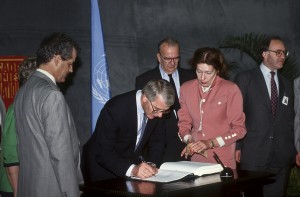
Twenty years ago, 172 of the world’s leaders, including 108 Heads of State – our own Prime Minister John Major and the US President George Bush (the elder) included – met in Rio de Janeiro, Brazil for a groundbreaking world conference, the United Nations Conference on Environment and Development, UNCED. They signed into effect two crucial United Nations treaties; the Climate Change Convention and the Biodiversity Convention.

These two binding treaties, together with three further agreements – Agenda 21, the Rio Declaration and the Statement on Forest Principles – were the basis for a plethora of effective and forward-looking projects, programmes and laws, on every level from the smallest Agenda 21 project affecting just a small plot of community land to international efforts to control climate change and protect biodiversity.

John Major signing the Biodiversity Convention, UNCED 1992

John Major signing the Biodiversity Convention

The development of these has been patchy and has fallen short of hopes and expectations, but overall we are in a very much better position in the 21st century than would have been the case without UNCED.

But all the gains made on the environmental front have been overshadowed by the explosive growth in consumption and the rapid expansion of trans-national corporations (TNCs) whose motivation is driven by only one thing – profit. In 1990 there were 3,000 TNCs; today there are 63,000!

The intervening years have also seen the establishment of the World Trade Organsiation (WTO), the most powerful and effective UN organisation ever. Often the WTO is in direct conflict with the vital needs of the environment, and sadly it is usually the WTO which takes precedence.

Where To Now?

Environment in second place to profit – danger of environmental disintegration – need for change – the place of indigenous people – Running Out Of Time – TNCs as part of the solution with their resources and dynamism.

If we carry on along the road we are on, the interests of the environment will always take second place to those of the TNCs and international finacial institutions, with disastrous consequences – spiralling environmental degradation, ever-diminishing water resources, out-of-control climate change and growing human impoverishment. We need to change. And Rio+20 is an excellent focus through which we can initiate that change.

Asurini Woman with Sweet potatoes

Asurini Woman with Sweet potatoes

The indigenous people who will attend Rio+20 are charismatic and visually compelling. Because their entire cultures and ways of life depend on their close interrelationship  with the natural environment they will be putting the case for protecting the planet’s wild ecosystems in a robust way.

Scientists, environmentalists and civil society groups are worried that time is running out. Unfortunately the draft proposals from the UN for Rio+20 are weak, non-binding and a poor compromise. The only way that something positive will come out of Rio is if the non-UN sector comes together with one voice to demand change.

And change can come. Within the TNCs there is a growing awareness that they are locked into a dangerous path of growing and unsustainable natural resource consumption, but they are effectively prisoners of the profit motive – which is underpinned by legal obligations and hemmed in by the underlying structure of our world economy.

Petrobras Research Centre

Petrobras Research Centre

We need the TNCs to become part of the solution to the problem, because they control the bulk of the resources we need to rapidly re-focus the economy. By the year 2000, 53 of the largest economic entities in the world were corporations, not countries, each one with more wealth than over 120 nation states. We need their resources, we need their expertise and we need their entrepreneurship if we are to change the course of humanity in time to head off climate change and resource over-exploitation before it is too late.

Indigenous People; Part of the Solution

Indigenous people suffering from resource over-exploitation, have the understanding and spiritual relationship with the Earth – their long-term view to the sixth generation.

Indigenous people are at the receiving end of this over-exploitation. It is they whose land is scarred and despoiled by mining operations, it is they whose villages are flooded – or denied water – by mega hydroeletric dams, and it is they whose sources of sustenance and well-being are stolen when the forest is felled to make way for soya, cattle and biofuels. Pressures on indigenous people the world over have been ratcheting up rapidly in the 21st century and show no signs of reducing.

Warrior Phinya Matipu

Warrior Phinya Matipu

Yet it is also they who have the understanding of the natural environment and the respect for the balance inherent in a proper relationship between man and nature. Their strong spiritual belief in man’s integration in the totality of the global environment would not have allowed them to embark on the profligate and careless despoilment of the earth which we have seen in the last 250 years. They plan with the well-being of the next six generations in mind; with that as a starting point we could never have made the myriad wrong turns we have.

We need to listen to them. We need to take on board the interests of the sixth generation. Our planning cannot be in terms of five-year plans, nor can we base our politics on the need to face the electorate in a few years. Our idea of long-term planning is inadequate and pitiful.

What Can Rio+20 Deliver?

The Future We Want, Rio+20With the UN’s ambition practically at zero, Rio+20 has to look to a movement of the peoples of the world, indigenous and rural, urban and metropolitan, remote and mainstream, for any progress. By uniting people in a call for change, in a shout for the re-balancing of civilisation, Rio+20 can be the starting point for a dynamic shift in public perception which will force our national and international institutions to re-shape themselves.

Let’s do it!


Would you like to know more? For a longer discussion in pdf format, go here